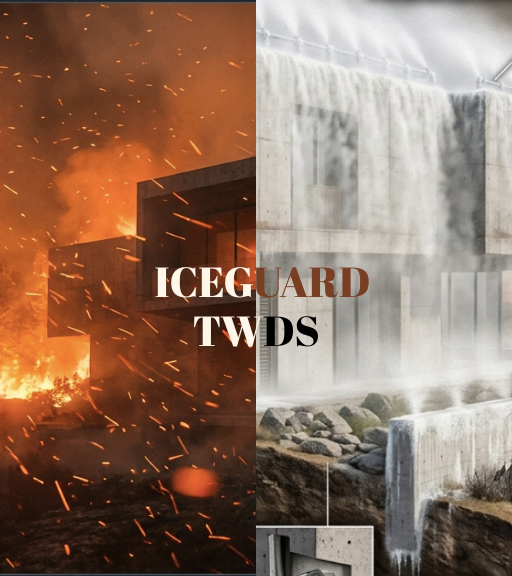
The Science of ICEGUARD™: Active Thermodynamic Defense
When Water Fails, Thermodynamics Prevails
In extreme Wildland-Urban Interface (WUI) fires, ambient temperatures can exceed 800°C, driven by dry winds of 60+ mph. Under these conditions, traditional water sprinklers fail: droplets flash-evaporate or are carried away by wind before they ever reach the flame front.
Surviving a modern wildfire event demands more than passive protection. Structures need an active, autonomous defense system engineered to absorb immense thermal energy — not just spray water at it.
The ICEGUARD™ Thermodynamic Wildfire Defense System shifts the paradigm from passive water spraying to active thermodynamic defense, grounded in peer-reviewed science.
Research-Supported Engineering for Wildfire Resilience
ICEGUARD™ is built on established scientific principles spanning wildfire engineering, thermodynamics, water-mist suppression, radiant heat transfer, autonomous sensing, and resilient infrastructure.
Rather than depending on a single innovation, ICEGUARD integrates multiple engineering disciplines into one cohesive platform — a conceptual framework designed for professional development, rigorous testing, and project-specific implementation.
Scientific Foundation
Modern wildfire protection combines multiple physical processes that work together to reduce ignition risk and improve building resilience.
The conceptual architecture explored within ICEGUARD is informed by published research in:
- Water-mist fire suppression
- Phase-change thermodynamics
- Radiant heat attenuation
- Surface heat-flux removal
- Autonomous monitoring
- Wildfire engineering
- Fire dynamics
- Resilient infrastructure
Each of these fields contributes to the overall engineering philosophy of the platform.
Thermodynamic Heat Reduction
The Science of Water Mist Cooling
One of the primary engineering concepts explored within ICEGUARD is the use of finely atomized water to absorb thermal energy from the surrounding environment.
Published research demonstrates that water mist creates extremely small droplets with a high surface-area-to-volume ratio. As these droplets rapidly evaporate, they absorb significant amounts of heat through the latent heat of vaporization, reducing temperatures within the surrounding gas layer.
This mechanism has been shown to:
- Absorb thermal energy from hot gases
- Cool localized environments
- Reduce smoke-layer temperatures
- Delay thermal escalation
ICEGUARD incorporates this well-established thermodynamic principle as part of its conceptual engineering architecture. Actual cooling performance depends on factors including nozzle configuration, water flow, environmental conditions, and system design.
Radiant Heat Attenuation
Reducing Thermal Exposure
Research conducted using computational fluid dynamics has shown that airborne water droplets can reduce the radiant heat reaching a protected structure.
Studies indicate that properly configured water-mist systems may attenuate approximately 6% to 26% of incident radiant heat under modeled wildfire conditions.
Reducing radiant heat exposure can help lower the thermal load imposed on exterior building components and complement other wildfire mitigation strategies.
The ICEGUARD conceptual platform investigates how coordinated deployment of atomized water may contribute to this protective effect as part of a broader engineering system.
Surface Heat Flux Removal
Protecting Building Envelopes
Scientific investigations have also demonstrated that water applied directly to exterior building surfaces can remove substantial thermal energy.
Experimental and numerical studies report that appropriately designed systems may remove heat fluxes approaching 30 kW/m² from exposed wall surfaces under certain conditions.
This rapid transfer of thermal energy helps reduce surface temperatures and may delay ignition of combustible materials when combined with appropriate building design.
ICEGUARD incorporates this principle into its conceptual thermal management strategy.
Integrated Engineering Approach
Wildfire resilience is rarely achieved through a single technology.
The ICEGUARD concept integrates multiple engineering systems, including:
- Environmental sensing
- Intelligent control logic
- Hydraulic distribution
- Water-mist deployment
- Thermal management
- Independent power systems
These systems are intended to function together as an integrated conceptual platform supporting project-specific engineering.
Insurance and Financial Risk
Wildfire Mitigation and Insurance
California has increasingly recognized wildfire mitigation as an important factor in property risk assessment.
Programs such as the California FAIR Plan currently offer premium discounts of up to 24.5% for qualifying wildfire-hardening measures, while California’s Safer from Wildfires regulation requires admitted insurers to consider documented wildfire mitigation during underwriting.
The financial benefit of any specific project depends on the completed design, eligibility requirements, insurer underwriting practices, and applicable regulations.
The ICEGUARD concept is intended to support future project teams in pursuing comprehensive wildfire resilience strategies that may contribute to improved risk profiles.
Value for Developers
For developers and asset owners, wildfire resilience extends beyond life safety.
Potential benefits of professionally engineered mitigation strategies may include:
- Reduced operational risk
- Enhanced asset resilience
- Lower lifecycle risk exposure
- Improved insurability
- Greater investor confidence
- Increased financing flexibility
- Reduced interruption following wildfire events
Research References
The ICEGUARD™ engineering philosophy is supported by published research across wildfire engineering, fire dynamics, thermodynamics, heat transfer, and resilient infrastructure. These references support the scientific principles incorporated into the conceptual wildfire defense system.
Wildfire Engineering & Radiant Heat Shielding
Natural Hazards Research Australia. (2022). Sprinkler Systems for the Protection of Buildings from Wildfire.
Provides computational fluid dynamics (CFD) analysis demonstrating how water-based sprinkler systems and mist curtains can reduce radiant heat exposure to buildings and improve wildfire resilience.
Dombrovsky, L. A., & Dembele, S. (2022). An Improved Solution for Shielding of Thermal Radiation from Fires Using Mist Curtains of Pure Water or Seawater. Computational Thermal Sciences, 14(4), 1–18.
Investigates the effectiveness of water-mist curtains in attenuating thermal radiation from large fires, including optimization of droplet characteristics and shielding performance under various environmental conditions.
Ko, G. H. (2023). Fire Dynamics Simulator Analysis of Smoke Confinement and Radiation Shielding Using Water Mist Curtains. International Journal of Fire Science and Engineering, 37(1), 22–31.
Uses Fire Dynamics Simulator (FDS) modeling to evaluate the performance of water-mist curtains in reducing smoke propagation and shielding structures from radiant heat during fire events.
Thermodynamics & Water Mist Fire Suppression
MDPI. (2024). Experimental and Numerical Studies on the Efficacy of Water Mist to Suppress Hydrocarbon Fires in Enclosures.
Examines the thermodynamic behavior of atomized water droplets, including rapid heat absorption through evaporation, cooling of hot gases, and suppression of fire development.
Phase-Change Heat Transfer & Ice Slurry Research
Wang, M., et al. (2021). Orthogonal Experimental Study on Heat Transfer Optimization of Backfill Slurry with Ice Particles. Advances in Civil Engineering, Volume 2021, Article ID 6684822.
Investigates the thermal behavior of ice-particle slurry systems and demonstrates enhanced heat transfer characteristics through phase-change processes. While focused on civil engineering applications, the research provides valuable insight into latent heat absorption mechanisms relevant to thermodynamic cooling concepts.
Wildfire Insurance & Financial Risk
California Department of Insurance. Safer from Wildfires Regulation (Insurance Code Section 2644.9).
Establishes California’s regulatory framework requiring admitted insurers to consider qualifying wildfire mitigation measures during underwriting and pricing decisions.
California FAIR Plan Association. Wildfire Mitigation and Home Hardening Guidelines.
Describes qualifying wildfire-hardening measures that may be eligible for insurance premium discounts under applicable program requirements.
Casualty Actuarial Society. (2022). Catastrophe Models for Wildfire Mitigation: Quantifying Credits and Benefits to Homeowners.
Discusses actuarial approaches for incorporating wildfire mitigation into catastrophe modeling and evaluating insurance premium credits associated with risk reduction measures.
Scientific Integrity Statement
The ICEGUARD™ Genesis Engineering Portfolio is a conceptual engineering work informed by peer-reviewed scientific literature, engineering research, computational modeling, and current wildfire resilience practices.
The references presented on this page support the underlying engineering principles incorporated into the conceptual platform, including water-mist suppression, thermodynamic heat absorption, radiant heat attenuation, phase-change cooling, and wildfire risk mitigation.
These publications do not constitute independent testing, certification, or validation of ICEGUARD™ as a completed commercial product. Any implementation requires project-specific engineering, testing, regulatory review, and approval by qualified professionals and the applicable Authority Having Jurisdiction (AHJ).
Genesis Release
Acquire an ICEGUARD™ commercial IP license
The Manifold claim opens July 27, 2026. A maximum of 318 ERC-1155 Genesis licenses will ever exist, offered at the initial price of 3,180 USDC — rising to 4,997 USDC after the first-mover allocation is claimed. Each license is verified on Base and governed by a commercial license agreement.
Purchasing the token does not provide a construction-ready system or transfer copyright ownership. Review the commercial license agreement before acquiring.